/
El Teatro Campesino - Latino USA Episode 416
This episode centers on a conversation between Maria Martin and Luis Valdez, founder of El Teatro Campesino. It aired on March 31, 2001.


El Teatro Campesino was born out of the Delano Grape Strike in 1965 when Luis Valdez pitched the idea of theatre by and for farm workers to Cesar Chavez. It became the cultural arm of the United Farmworkers Movement. Humble beginnings of one act socio-political skits that dramatized the plight and cause of the immigrant farmworkers led to critical acclaim. By the 1980’s the company had toured across the United States and México, with six major tours throughout Europe.
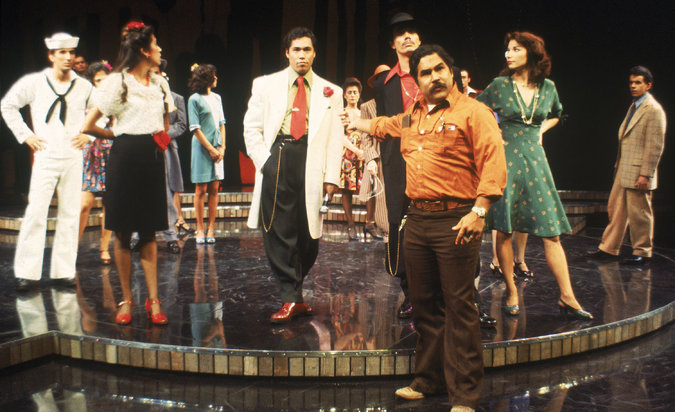
In 1978 Luis Valdez created Zoot Suit, according to their website it is one of the most successful plays ever to originate in Los Angeles and the first play by a Latino to be presented on Broadway. Zoot Suit also landed a motion picture deal with Universal Studios.
This opened the door for Luis Valdez to write and direct La Bamba, the story of Ritchie Valens. El Teatro Campesino and Luis Valdez’s legacy is considered a major catalyst for the explosion of Chicano arts. According to American Theatre Magazine, “The Teatro gave Chicano audiences in particular a sense of belonging in a society that had ignored and suppressed them for generations.” Themes of cultural identity, prejudice and discrimination are central to several of Luis Valdez’s works. According to El Paso Matters, La Bamba and Zoot Suit were added to the National Film Registry by the Library of Congress as being “culturally, historically, or aesthetically significant.”

Additional Resources
Articles
Seifrit-Griffin, Stacie . “Cesar Chavez, Family and Filmmaking with Luis Valdez.” Now See Hear!, 27 Mar. 2024, blogs.loc.gov/now-see-hear/2024/03/cesar-chavez-family-and-filmmaking-with-luis-valdez/.
Videos
“El Teatro Campesino Archives.” Internet Archive, UC Santa Barbara Library, Department of Special Research Collections, 2025, archive.org/details/teatrocampesino?tab=collection.
Digital Theatre+, et al. Zoot Suit / L.A. Theatre Works : Production. Directed by Luis Valdez, L.A. Theatre Works, 2024.
McGrath, Alice, et al. Luis Valdez’ Zoot Suit Symposium 2004. Symposium Presented by the University of Texas at Austin, UT Performing Arts Center, Austin Community College. Volume 1, A Retrospective of the Play : 1978-2004. University of Texas at Austin, 2004.
Works Cited:
El Teatro Campesino. “Our History | El Teatro Campesino.” El Teatro Campesino, elteatrocampesino.com/our-history/. Accessed 30 Oct. 2025.
Wikipedia contributors. "El Teatro Campesino." Wikipedia, The Free Encyclopedia. Wikipedia, The Free Encyclopedia, 19 Oct. 2025. Web. 30 Oct. 2025.
Wikipedia contributors. "Luis Valdez." Wikipedia, The Free Encyclopedia. Wikipedia, The Free Encyclopedia, 23 Oct. 2025. Web. 31 Oct. 2025.
“El Teatro Campesino.” UCSB Library, 19 Aug. 2011, www.library.ucsb.edu/special-collections/cema/etc. Accessed 30 Oct. 2025.
Ramirez, Cindy. “Luis Valdez Put Chicano Life on Stage and Screen with “Zoot Suit” and “La Bamba.” That’s Only Half His Story.” El Paso Matters, 13 July 2025, elpasomatters.org/2025/07/13/plaza-classic-2025-luis-valdez-appearance-la-bamba-zoot-suit/. Accessed 30 Oct. 2025.
Huerta, Jorge A. “El Teatro’s Living Legacy.” American Theatre, 21 Nov. 2016, www.americantheatre.org/2016/11/21/el-teatros-living-legacy/. Accessed 30 Oct. 2025.
00:00 - 00:12
This is Latino USA, the radio journal of news and culture. [Intro Music]
Maria Martin
00:12 - 00:15
Maria Hinojosa is on assignment, I'm Maria Martin.
Maria Martin
00:15 - 00:28
On this special edition of our program, we remember farmworker leader Cesar Chavez by recalling 35 years of the theater that grew out of the farmworkers movement, El Teatro Campesino.
Maria Martin
Cesar Chavez
El Teatro Campesino
00:28 - 00:38
Teatro had a tremendous impact because it gave people the courage and the vision and also made it possible for them to laugh at themselves during a hard, hard struggle.
Luis Valdez
El Teatro Campesino
00:38 - 00:44
El Teatro Campesino, its past, present and future, in the words of Teatro founder Luis Valdez.
Maria Martin
El Teatro Campesino
00:44 - 00:54
I was six years old when I met Cesar Chavez. He used to come to my house when I was a little kid. He lived on the same street where I was born.
Luis Valdez
Cesar Chavez
00:54 - 00:58
That's coming up on this special edition of Latino USA.
Maria Martin
00:58 - 01:08
[Music]
Music
01:08 - 01:22
I see the work of the Teatro as being a Chicano Latino theater company over the years, but it's been more than that. It's been a cultural institution. I think we've had an impact not just as a theater company, but as a mover, a mover and a shaker.
Luis Valdez
El Teatro Campesino
Theater
Chicano Movement
01:22 - 01:34
[Music]
Music
01:34 - 01:44
I'm Maria Martin. For more than 35 years now, the theater company El Teatro Campesino has brought the Chicano and Latino experience to the American stage.
Maria Martin
El Teatro Campesino
Theater
Representation
01:44 - 02:02
Once a ragtag troupe performing in the great fields of California, it staged the back of a flatbed truck. El Teatro Campesino has made its mark from movies to Broadway, training a now veteran generation of Latino actors and directors and influencing a new generation.
Maria Martin
California
El Teatro Campesino
Theater
02:04 - 02:06
Where's our warm-up coach? I'm just, I'm getting everybody. Do you want any more people?
Nat Sound
El Teatro Campesino
02:10 - 02:22
It's full in San Juan Bautista, California, the tranquil California mission town that Teatro Campesino, the farmworker's theater, has called home for over three decades.
Maria Martin
San Juan Bautista CA
El Teatro Campesino
02:30 - 02:44
Like most days, it's busy at the old packing shed that Teatro Campesino converted to its theater and headquarters. Kinan and Anahuac Valdez, both young directors, actors and filmmakers, are busy rehearsing a new play.
Maria Martin
El Teatro Campesino
Theater
02:44 - 02:56
And in the Teatro's recording studio, their uncle, singer, composer and actor Daniel Valdez, is recording the soundtrack of the Teatro's annual miracle play, The Virgen of Tepeyac.
Maria Martin
El Teatro Campesino
Theater
The Virgen of Tepeyac
02:56 - 03:06
[Singing]
Singing
03:06 - 03:23
Many of those who will act in this play this year have done so countless times before. Some 10, 20 or even 30 years. Like the Teatro Campesino itself, it's become a tradition, an expression of community and familia.
Maria Martin
El Teatro Campesino
Theater
03:23 - 03:29
Teatro Campesino is corazón de la gente. It's what our soul is about and it touches it.
Sound Bite
El Teatro Campesino
03:29 - 03:33
I've always thought of Teatro Campesino as being the mirror image of us.
Sound Bite
El Teatro Campesino
03:33 - 03:40
There's a lot of theater all over the country, but there's only one, El Teatro Campesino.
Sound Bite
El Teatro Campesino
03:41 - 03:49
El Teatro Campesino is now practically an institution for many Latinos, especially for Mexican-Americans in the Southwest.
Maria Martin
El Teatro Campesino
US Southwest
03:49 - 04:08
That's because El Teatro Campesino, which has produced television programs and motion pictures, and has been the spawning ground for some well-known Latino actors, has its roots in the very beginning of an important historical movement for Latinos, the Chicano movement for social and political recognition.
Maria Martin
El Teatro Campesino
Chicano Movement
04:08 - 04:13
For the Teatro Campesino, it all started back in 1965.
Maria Martin
El Teatro Campesino
Year 1965
04:13 - 04:20
To whom it may concern, there is an interest in establishing a bilingual community farm workers theater.
Excerpt
El Teatro Campesino
Year 1965
Delano CA
04:20 - 04:25
The primary aim of this theater would be to belong to the workers themselves.
Excerpt
El Teatro Campesino
Year 1965
Delano CA
04:25 - 04:30
It is time the Raza landed the artistic blow it is capable of giving.
Excerpt
El Teatro Campesino
Year 1965
Delano CA
04:30 - 04:35
Those interested in attending an organizational meeting, please sign below.
Excerpt
El Teatro Campesino
Year 1965
Delano CA
04:35 - 04:38
The place was Delano, California.
Maria Martin
El Teatro Campesino
Year 1965
Delano CA
04:38 - 04:44
This was the text of a leaflet which announced the formation of a theater troupe quite unlike any before.
Maria Martin
El Teatro Campesino
Year 1965
Delano CA
04:44 - 04:58
It was influenced by La Barraca, the 1930s traveling theater of Spain's Federico García Lorca, by the Mexican burlesque style known as Carpa, and by the work of the German playwright Bertholt Brecht.
Maria Martin
El Teatro Campesino
Year 1965
Delano CA
04:58 - 05:08
But the actual spark that led to the founding of El Teatro Campesino was something known simply as La Huelga, the farm workers movement for social justice.
Maria Martin
El Teatro Campesino
Year 1965
Delano CA
Labor Organizing
La Huelga
05:08 - 05:14
[Chanting] Huelga! Huelga!
Chanting
Year 1965
Labor Organizing
La Huelga
05:14 - 05:21
Farm workers had gone on strike in September of 1965, led by labor organizer Cesar Chavez.
Maria Martin
Year 1965
Cesar Chavez
Labor Organizing
05:21 - 05:35
At the beginning, it was very much a David and Goliath scenario. Farm workers had no political voice, the growers were very powerful. It was just the inspiration that an optimistic young Chicano playwright needed.
Maria Martin
Year 1965
Luis Valdez
Labor Organizing
05:35 - 05:48
Now the night that I left San Francisco for Delano, I was talking to this guy from the Free Southern Theater, which was also an inspiration because they were black actors from New York City touring the south in 1964-65.
Luis Valdez
Delano CA
Free Southern Theater
05:48 - 05:52
And I was talking to one of them, a guy by the name of Murray Levy, and he said,
Luis Valdez
Delano CA
Murray Levy
05:52 - 06:10
You're going down there to start a theater company? And I said, Yeah, you know. With what? Do you have any money? I said, No. No funding? No. Do you have a board of directors? No. Do you have any actors? No. Do you have any scripts? No.
Luis Valdez
Delano CA
Murray Levy
El Teatro Campesino
06:10 - 06:16
He says, How are you going to do it? And I said, I don't know. But I'm going to do it.
Luis Valdez
Delano CA
Murray Levy
El Teatro Campesino
06:16 - 06:20
If you believe in something, it becomes true.
Luis Valdez
Delano CA
El Teatro Campesino
06:20 - 06:25
Luis Valdez came from a family of migrants from the San Joaquin Valley.
Maria Martin
Luis Valdez
San Joaquin Valley
06:25 - 06:30
His family had moved north, and Valdez had studied drama at San Jose State. He'd also done a stint with the San Francisco Mime Troupe.
Maria Martin
Luis Valdez
06:33 - 06:42
At that time, I was aware that the problem with trying to be a Chicano playwright in America was that there was no such thing as Hispanic theater in America.
Luis Valdez
Theater
Representation
06:42 - 06:49
There was community Hispanic theater, but professional Hispanic theater in America was almost nonexistent.
Luis Valdez
Theater
Representation
06:49 - 06:56
So I saw it as a challenge, you know. Here's a challenge to try to fill this gap, this hole, this enormous vacuity.
Luis Valdez
Theater
Representation
06:56 - 07:12
We're at the Teatro Campesino, the farmworkers theater from Delano, California. And we've come here this evening to tell you the story of our strike, our huelga, and of our union, the United Farm Workers Organizing Committee, AFL-CIO led by Cesar Chavez.
Excerpt
El Teatro Campesino
Delano CA
Labor Organizing
Cesar Chavez
United Farm Workers
La Huelga
07:12 - 07:18
Teatro's early performances were simple, agitprop pieces. Valdez called them actos.
Maria Martin
El Teatro Campesino
Theater
07:18 - 07:29
Bilingual, one-act skits using broad characters. The grower, el patroncito. The strikers, los huelguistas. And los esquirolaes, the scabs.
Maria Martin
El Teatro Campesino
Theater
07:29 - 07:44
In those days, there were no sets, no costumes. The actors wore signs around their necks with their characters' names. The stage was the back of a flatbed truck. It was, says Valdez, our own brand of commedia dell'arte.
Maria Martin
El Teatro Campesino
Theater
07:48 - 07:54
[Singing]
Singing
08:01 - 08:07
Through music, song, and drama, the members of the Teatro gave the Huelga animo.
Maria Martin
El Teatro Campesino
La Huelga
08:07 - 08:13
They kept the strikers' spirits up and even persuaded some of the strike breakers to join up.
Maria Martin
El Teatro Campesino
La Huelga
08:13 - 08:19
Years later, Cesar Chavez recalled the impact that el Teatro Campesino had on his movement.
Maria Martin
El Teatro Campesino
La Huelga
08:19 - 08:37
Teatro and the struggle really made a difference for us. Luis was able to get people who had been on strike three months, four months, six months a year to laugh at their own conditions, to look at themselves, and to join with us laughing about the injustices and the growers who were committing those injustices against them.
Cesar Chavez
Excerpt
El Teatro Campesino
La Huelga
08:37 - 08:50
Teatro had a tremendous impact, and one of the factors why we won that strike, because it gave people the courage and the vision, and also made it possible for them to laugh at themselves during a hard, hard struggle.
Cesar Chavez
Excerpt
El Teatro Campesino
La Huelga
08:50 - 09:01
[Singing] Campesinos Mexicanos, Americanos de Color, Puerto Rico...
Singing
09:01 - 09:08
The first striker to join the Teatro was Agustin Lira, then a 21-year-old migrant from Coahuila, Mexico.
Maria Martin
El Teatro Campesino
La Huelga
09:08 - 09:29
Strangely enough, I was working in the fields around Stockton, Sacramento, and I bought a newspaper and I picked it up, and it said that there was a strike going on, you know, and I'm very sure that I, inside of my soul, I was looking for an opportunity to fight back, because my parents had been farmworkers.
Agustin Lira
Labor Organizing
La Huelga
09:29 - 09:36
And we had never had a chance to fight for better wages, but of course we were exploited.
Agustin Lira
Labor Organizing
La Huelga
09:36 - 09:45
[Singing] Viva la virgen de guadalupe, viva nuestra union!
Singing
09:45 - 10:03
35 years after the Huelga, I spoke with director and Teatro Campesino founder, Luis Valdez, at his theater in San Juan Bautista about the past and the present.
Maria Martin
El Teatro Campesino
San Juan Bautista CA
La Huelga
10:03 - 10:09
It was very inspiring to walk into the Teatro Campesino here in San Juan Bautista, and there was so much going on, there was so much energy here.
Maria Martin
El Teatro Campesino
San Juan Bautista CA
10:13 - 10:18
Is this the old spirit? Is there a new spirit?
Maria Martin
El Teatro Campesino
10:18 - 10:23
Well, fortunately, it's both the old and the new, you know, coming together and meeting head-on, so to speak.
Luis Valdez
El Teatro Campesino
10:23 - 10:39
We have a new generation that was born into the Teatro. They're in their 20s, starting to push 30, which means that they're entering a real age of responsibility here, organizationally speaking, in addition to the creative impulse and spark. So that's real good for the company, you know.
Luis Valdez
El Teatro Campesino
10:39 - 10:54
You know, every organization is like a living organism, and like a human being, an organism, an organization sometimes has to take a break, has to take a rest, they have mental breakdowns, they have moments of exhaustion where they have to sleep. Organizations do sleep.
Luis Valdez
El Teatro Campesino
10:54 - 11:01
So the rhythms come and go, and it's been an amazing year. This is a real important year for us.
Luis Valdez
El Teatro Campesino
11:01 - 11:06
It's not just our 35th anniversary year, it's what comes after 35 years.
Luis Valdez
El Teatro Campesino
11:06 - 11:21
It's a certain kind of solidity and experience and patience and family cohesion and generational bonding, transgenerational bonding that you can actually harvest after many years of work.
Luis Valdez
El Teatro Campesino
11:21 - 11:36
When you look back at 35 years of the Teatro Campesino and all of its manifestation, what or how would you characterize what its continuing legacy is?
Luis Valdez
El Teatro Campesino
11:36 - 11:58
I think the reality of El Teatro is cultural, and I understand it a lot better now than I did, you know, when it started. It was an impulse then that came from a 25-year-old on my part, you know, and you can only really see so far when you're 25. You've got a lot of energy and a lot of faith,
Luis Valdez
El Teatro Campesino
11:58 - 12:15
but I couldn't see the future beyond a certain point. So I did it anyway, and I jumped into the grape strike, and the idea of starting and maintaining a farmworker's theater was a day-to-day, week-to-week, month-to-month challenge.
Luis Valdez
El Teatro Campesino
Year 1965
La Huelga
12:15 - 12:21
After a while, the process itself began to raise questions of how long we were going to survive and how we were going to survive.
Luis Valdez
El Teatro Campesino
12:21 - 12:28
When members started to get older and develop families, it became a much more serious question of how we were going to maintain and support everybody.
Luis Valdez
El Teatro Campesino
12:28 - 12:32
We couldn't all just live on the wing, you know, as we did back when.
Luis Valdez
El Teatro Campesino
12:32 - 12:37
So the struggle all along has been to create and maintain the context that's going to support the Teatro.
Luis Valdez
El Teatro Campesino
12:37 - 12:53
You've got to understand how the Teatro looked at the very beginning. People can say, okay, the Teatro started in 1965, but it wasn't just the Teatro. The farmworker's movement was going on. The Chicano movement started at that time as well, as far as I'm concerned.
Luis Valdez
El Teatro Campesino
Year 1965
Chicano Movement
13:47 - 13:59
The Teatro was a way to change our country, the country that we lived in, to make some room for us, give us some opportunities in education, in politics, in the commercial world, you know, in the corporate, whatever.
Luis Valdez
El Teatro Campesino
Representation
13:59 - 14:08
That's what began. And in order for the Teatro to exist as, say, a regional theater, you had to have all those elements that support regional theaters.
Luis Valdez
El Teatro Campesino
14:08 - 14:21
You had to have a community made up of not just working-class people, but also the middle class and working professionals, who helped then the organizations within the community to get the money that they deserve.
Luis Valdez
14:21 - 14:29
The theater that we were interested in, which was a commercial venue, a restored movie theater, is still an old movie theater, has not been restored.
Luis Valdez
14:29 - 14:34
But in any case, had we gone in there, we would have needed municipal and corporate support to maintain.
Luis Valdez
14:34 - 14:46
For one reason or another, it didn't happen, has not happened yet. There isn't a single regional-level style theater that relates to Latinos in the state of California.
Luis Valdez
California
Representation
14:46 - 15:03
So back when we started, it was basically an empty plane. And I knew that as a playwright. Here I was a playwright without an audience, a playwright without a theater that could produce my works, a playwright without actors, Latino actors that could do my roles.
Luis Valdez
Theater
15:04 - 15:20
So I had to begin to write to my reality. And so agitprop and the acto level, and later the mito and the corrido, was the way that I could survive as a theater artist by not overtaxing, if you will, the preparation of my actors and my audience.
Luis Valdez
Theater
Mito
Corrido
Political
15:20 - 15:26
Political theater made perfect sense. It was free. That makes a lot of sense to an audience.
Luis Valdez
Theater
Political
15:26 - 15:33
But it was passionate. And it was pointed at an action that they could also participate in. So that allowed our survival.
Luis Valdez
Theater
Political
15:33 - 15:40
As we went on and got to Zoot Suit, and there I am at the Mark Taper Forum now as a playwright, and we were there with the teatro first.
Luis Valdez
Zoot Suit
15:40 - 15:45
We did a 10-day run at the Mark Taper Forum with Carpa de los Rasquachis in the mid-70s.
Luis Valdez
Carpa de los Rasquachis
The 1970s
15:45 - 15:50
That led to my being invited to commission to write a play for the Mark Taper Forum.
Luis Valdez
Theater
15:50 - 15:54
By that time, the audience in Los Angeles was willing to pay for theater tickets.
Luis Valdez
Theater
15:54 - 16:01
So that proved that, oh, Latinos can finally sustain commercial theater. The problem is that there has not been another one since then.
Luis Valdez
Theater
Representation
16:01 - 16:19
Zoot Suit told the story of racism against Pachucos in Los Angeles.
Maria Martin
Zoot Suit
Los Angeles
Identity
16:19 - 16:26
Pachucos were young Mexican-Americans who'd adopted the Zoot Suit style of dress during the time of the Second World War.
Maria Martin
Zoot Suit
Los Angeles
Identity
16:27 - 16:55
It was, said Valdez, a very American play. Zoot Suit is about American identity. The Zoot Suit phenomenon was something that was of the period of the early 40s.
Maria Martin
Zoot Suit
The 1940s
Identity
16:55 - 17:03
The whole country became Zoot Suit crazy. And of course I'm talking about the young people, those young people that were just about getting ready to go off to war.
Luis Valdez
Zoot Suit
Identity
17:03 - 17:16
What it meant for Chicanos is that they were identifying with the average American kids who were wearing Zoot Suits and saying, Hey, we're American. We love this music. We love this style. We're here, and we're doing it in our own way.
Luis Valdez
Zoot Suit
Identity
17:16 - 17:22
And so Zoot Suit became a symbol of Chicano identity, but also a symbol of American identity. So that's what the play's about.
Luis Valdez
Zoot Suit
Theater
Identity
17:23 - 17:35
Four hundred thousand people saw the production of Zoot Suit at the Mark Taper Forum in Los Angeles, where it ran for 46 weeks, with actor Edward James Olmos in the lead role of El Pachuco.
Luis Valdez
Zoot Suit
Theater
Los Angeles
Edward James Olmos
17:35 - 17:56
Before I got that phone call, I could not work in this community because there was nothing for me to do. I've been entertaining people since 1961. Here it is, 1978. I had not gained one penny from the American theater. The first paycheck I ever got was from Zoot Suit when I made 250 bucks a week for acting on stage.
Edward James Olmos
Acting
Year 1978
Zoot Suit
Representation
Theater
17:56 - 18:08
Actor Edward James Olmos, star of Stand and Deliver and Miami Vice, recalls he was a furniture mover when he was asked to audition for Zoot Suit and saw a script of the play.
Maria Martin
Zoot Suit
Edward James Olmos
Theater
18:09 - 18:31
Words never seen printed in my life. Words that I had heard all my life. Words that only could come from the heart and the passion and the understanding of the finest who command the language.
Excerpt
Edward James Olmos
Acting
Year 1978
Zoot Suit
Representation
18:31 - 18:36
I said, my lord, que le wacha mis trapos, ese?
Excerpt
Edward James Olmos
Acting
18:40 - 18:53
Ladies and gentlemen, the moment you're about to see is a construct of fact and fantasy. But relax, weigh the facts, and enjoy the pretense.
Edward James Olmos
Acting
Zoot Suit
Excerpt
18:53 - 19:12
Our Pachuco realities will only make sense if you grasp their stylization. It was a secret fantasy for Vivato, living in or out of the Pachucada, to put on the Zoot Suit and play the myth. Pues Orale!
Edward James Olmos
Acting
Zoot Suit
Excerpt
19:16 - 19:27
This is the fact, the fantasy, the music, the myth, the magic, the movie. Zoot Suit. Universal Pictures presents Zoot Suit, an American Original.
Excerpt
Zoot Suit
Film
19:41 - 19:51
[Music] Oh, Donna, oh, Donna, oh, Donna, oh, Donna.
Music
19:52 - 19:58
Seven years went by between the release of the film of Zoot Suit and Valdez's second film, La Bamba.
Maria Martin
Zoot Suit
La Bamba
Film
The 1980s
19:59 - 20:10
It was a time which saw what some call the Latinization of the United States. Everyone, from Linda Ronstadt to George Bush, it seemed, discovered their Hispanic connection.
Maria Martin
Representation
The 1980s
20:11 - 20:16
At last, the American cultural climate seemed to have caught up with the work of El Teatro Campesino.
Maria Martin
Representation
The 1980s
20:16 - 20:25
[Music]
Music
20:25 - 20:36
La Bamba, the story of 1950s singer Ricardo Valenzuela, better known as Ritchie Valens, grossed 55 million dollars in the United States, 90 million worldwide.
Maria Martin
La Bamba
Ritchie Valens
The 1980s
Film
20:41 - 20:51
What makes America great is that it is dynamic, and what makes any theater great or dynamic is the audience.
Luis Valdez
Theater
20:52 - 21:03
In Hollywood, they call it the Hispanic market. We know it to be simply the presence of millions and millions and millions of people that are attuned to the new realities of the Southwest.
Luis Valdez
Hollywood
US Southwest
Representation
21:04 - 21:10
Ten years ago, Luis Valdez had this to say about his experience as a Hollywood filmmaker.
Luis Valdez
Hollywood
21:11 - 21:20
Hollywood is an ongoing carnival, you know, deal-making. It's a game that can wear you down, and literally I think it wears people to the ground.
Luis Valdez
Hollywood
21:21 - 21:26
Ten years later, Valdez still has an uneasy relationship with the movie business.
Luis Valdez
Hollywood
21:27 - 21:36
I don't think the general public really understands completely how Hollywood works, and they only understand what they see, and what they see are movies that make it to theaters, but they don't understand it.
Luis Valdez
Hollywood
21:37 - 21:52
Not only is it a competitive business, but it's also a corporate business with corporate structures and multimillion dollar investments made by individuals in some cases, but more often than not by corporate combines, corporate investors.
Luis Valdez
Hollywood
21:52 - 22:08
Both inside the studio system and outside the studio system that expect a quick return for their money, and that quick return, if you look at most movies, is generated in the first couple of weekends.
Luis Valdez
Hollywood
22:09 - 22:29
And what is becoming the frightening norm for filmmakers that are attempting to work in LA or Hollywood slash planet Earth, because it's really a worldwide business, is the frightening thing is that if you don't make 20, 30 million dollars on your first weekend, you're not in competition.
Luis Valdez
Hollywood
22:29 - 22:49
And in order to ensure that, and some movies have made over 50 million on their first weekend, in order to ensure that they have to pack films with movie stars with a lot of flash, a lot of stuff that is really aimed at the target audience, in most cases the largest audience is the 17 to 25.
Luis Valdez
Hollywood
Film
22:50 - 23:15
So a film has to cater to those tastes, meaning action, meaning male action oriented films. And occasionally they allow themselves, these investors in studios to gamble with an unusual project. Occasionally a surprise comes along and a sleeper becomes a big hit. But there are limits. Nothing can compete with the big blockbusters.
Luis Valdez
Hollywood
Film
23:16 - 23:38
Though Luis Valdez is widely considered a pioneer, he himself doesn't consider his work nearly done yet. Last year, Valdez premiered a new original play, The Mummified Deer. Zoot Suit had a successful revival in Chicago. And in the long term, a number of important film projects remain on El Teatro Campesino's horizon.
Luis Valdez
The Mummified Deer
El Teatro Campesino
Theater
Film
Chicago
23:39 - 23:49
What is there left for you to do Luis? What do you still want to do? What are the dreams that perhaps are yet unfulfilled?
Maria Martin
23:50 - 24:12
Well, I have the movie on Cesar Chavez, you know, that I'm struggling. That's another protracted struggle. But for all the reasons that made Cesar who he was, this is another film that is a long time struggle. Maybe just because I've chosen, you know, this life of struggle that happens this way. But there's a lot of truth in it that California is not ready to acknowledge yet.
Luis Valdez
Cesar Chavez
Film
California
24:13 - 24:34
And I will continue to work with the family, with United Farm Workers, and with Hollywood in order to make that a reality. So the ultimate result though, and I know Dolores Huerta feels this way, is that maybe what that project is, is an independent film. You know, unrestrained by any corporate pressures. And I think probably Cesar would have appreciated that more.
Luis Valdez
Cesar Chavez
Film
Hollywood
United Farm Workers
Dolores Huerta
24:35 - 24:50
Poor, you know, in the sense that they won't have a huge budget, but it will be a labor of love and a labor of commitment, a political and social commitment, human commitment, which I think really explains who Cesar was. So maybe that's the way it'll get done.
Luis Valdez
Cesar Chavez
Film
Political
24:51 - 25:17
And don't be surprised if it comes out of this packing shed, because this is a very natural place for it to come out of. And really just looking at it, it's very difficult to take Cesar and to try to put him through the sieve of Hollywood. You know, it somehow doesn't work. And I think he knew that. He knew that for 10 years, the last 10 years of his life, when I was talking to him about this. He resisted the notion. He didn't want a Hollywood movie about him. He hated that stuff.
Luis Valdez
Cesar Chavez
Film
Hollywood
25:18 - 25:28
And I understand. I understand exactly what he meant. And so maybe it'll get done that way. Maybe it'll get done by somebody else. You know what I'm saying? But at least I will have carried the ball this far.
Luis Valdez
Cesar Chavez
Film
25:29 - 25:45
And I have written seven drafts of the Cesar Chavez story, some major drafts that deal with the history of the farm workers from my perspective and my experience in it. I was six years old when I met Cesar Chavez. And he was a pachuco. He was a zoot suiter who ran with one of my cousins.
Luis Valdez
Cesar Chavez
Film
25:45 - 25:57
So you see, what it comes to is the fact that really I'm talking about a member of my own family here. And that's the best way. This is the way I feel about it. So I'll try my best. And we shall proceed and persevere.
Luis Valdez
Cesar Chavez
Film
25:58 - 26:06
Director, playwright, filmmaker, cultural icon, and pioneer of the American theater, Luis Valdez.
Maria Martin
Luis Valdez
26:16 - 26:36
They forced the scholars to recognize that there is more than Western European theater. And as long as the companies that have been spawned by the Teatro Campesino and the playwrights that have been inspired by the Teatro Campesino continue to write and express their reality concerning their own communities, then the impact will continue to be felt.
Maria Martin
Luis Valdez
El Teatro Campesino
Representation
26:36 - 26:52
There are certainly playwrights out there who have, from the Chicano community, who have not necessarily been influenced by Luis Valdez per se. But without Luis Valdez having opened the doors in many of these institutions, then they would not even be listened to. They wouldn't be heard from.
Maria Martin
Luis Valdez
Representation
26:54 - 26:56
For Latino USA, I'm Maria Martin.
Maria Martin
26:56 - 27:20
[Music]
Music